The style guide nobody used became an AI system used everyday

Unibet · Kindred/FDJ Group · Regulated gambling ·  Content governance

Context

When I joined FDJ’s content design team, there was no definitive content design style guide for one of our main brands, Unibet. I led the team in creating one. Then, over the following months, we watched people not use it. They continued posting questions in Figma comments and Teams chat.

In a product operating under the UK Gambling Commission and other regulatory authorities across five markets, that matters. The absence of guidance is a compliance risk.
Problem

The style guide of about 67 pages lived in Confluence. In practice, that made it slow to search, awkward to use mid-flow, and easy to ignore. It became a last resort instead of a working tool.

As more teams started using AI to draft content, the problem got worse. Those tools had no context on our tone, terminology, or market-specific rules. Outputs drifted away from brand standards, and content needed more review and correction.

We had clear rules, but no efficient way to apply them at scale. The problem was not the quality of the guidance. It was friction at the point of use.

The solution

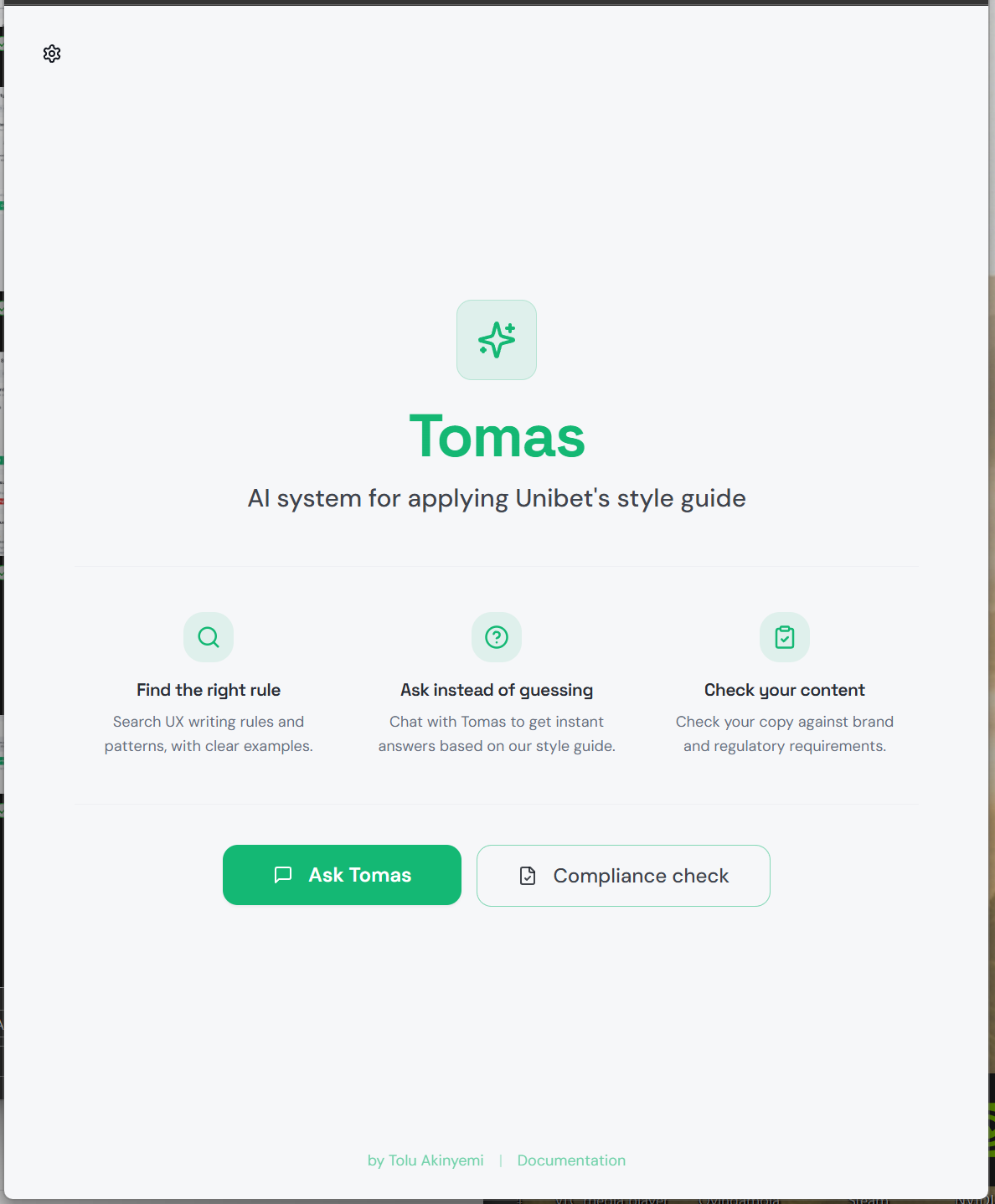
I designed Tomas, an internal AI content system to make Unibet’s style guide usable in real work.

Instead of teams searching long documents or relying on content designers for routine answers, Tomas makes the guidance available at the point of decision, for everyone.  It gives people a faster way to apply the right rules, using the same standards the content team works with across tone, terminology, and regulatory language.

Version one: what did not work

My first attempt was a custom ChatGPT bot with the style guide PDF uploaded to it, shaped by a set of prompts. It worked well enough to prove the idea,  but it had three problems I could not ignore.

No real interface
It lived inside ChatGPT, with no useful way of improving the user interface and interaction design.

Lag from manual updates
Every time a rule changed in Confluence, I had to re-upload the updated PDF. That created a lag between the official guide and what the tool was returning, which was terrible for a regulated environment.

No proper control layer
The behaviour of the system lived inside prompts, which meant it could not be configured, maintained, or evolved easily by the team.

Designing Tomas

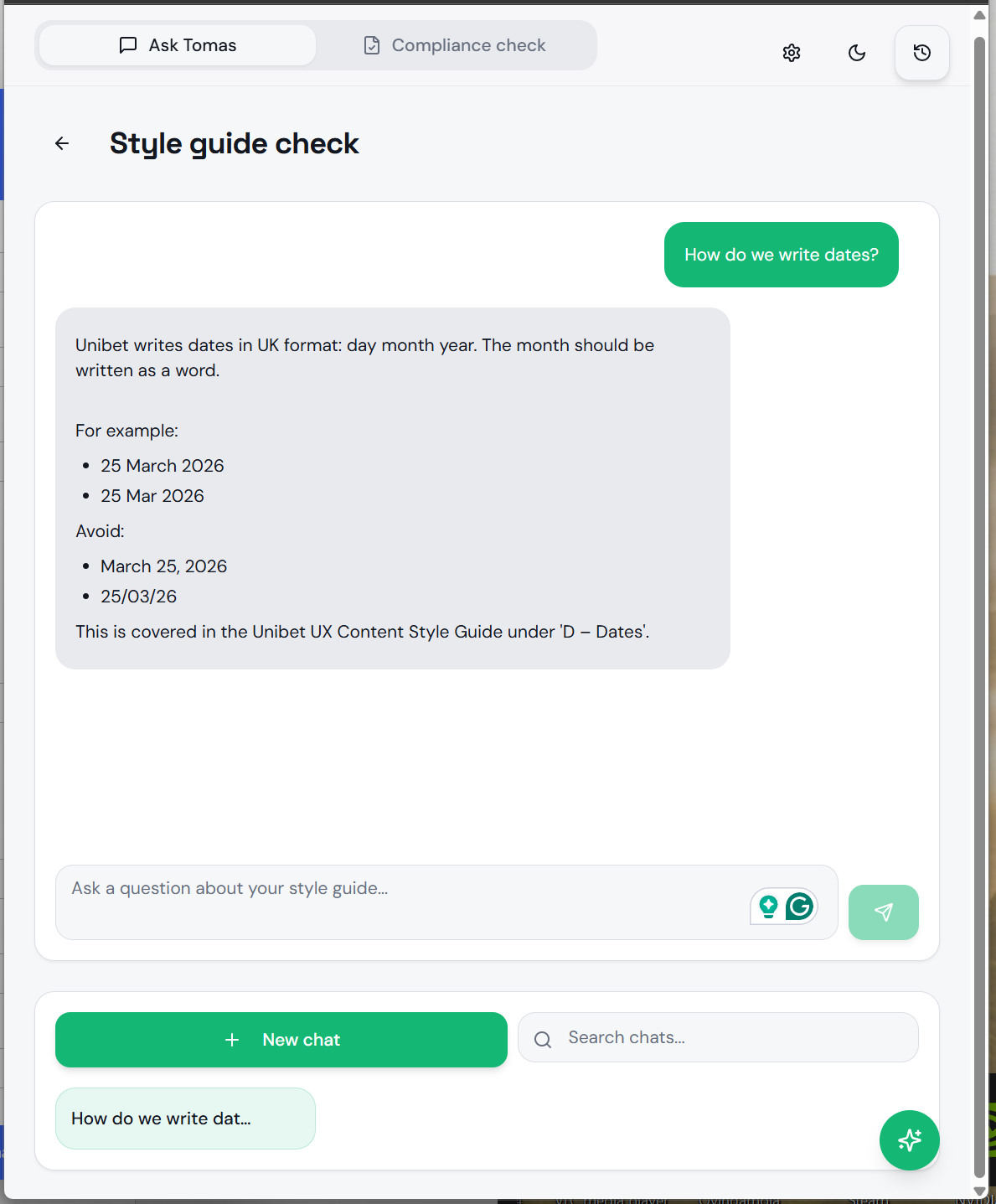
The iterated version of Tomas has two main modes: Ask Tomas and Compliance Check.

Ask Tomas

Ask Tomas is an AI conversational interface for style and content questions.

Anyone can type a question in plain language, the same way they would ask it in Teams or Slack, and get an immediate answer grounded in the system’s rules. The response gives a direct answer, points to the relevant rule, explains the reasoning, and shows examples of what to do and what to avoid.

Handling ambiguity without guesswork
When a query is ambiguous, Tomas does not guess. It offers a set of interactive, clickable interpretations based on what the user has asked, allowing them to clarify intent quickly without rewriting the whole question.

When relevant, Tomas can also offer a set of interactive, useful follow-up actions, such as showing examples or applying the same rule to a different content type.

This turns the interaction into guided decision-making rather than a one-shot response, and reduces the risk of confident but incorrect answers.

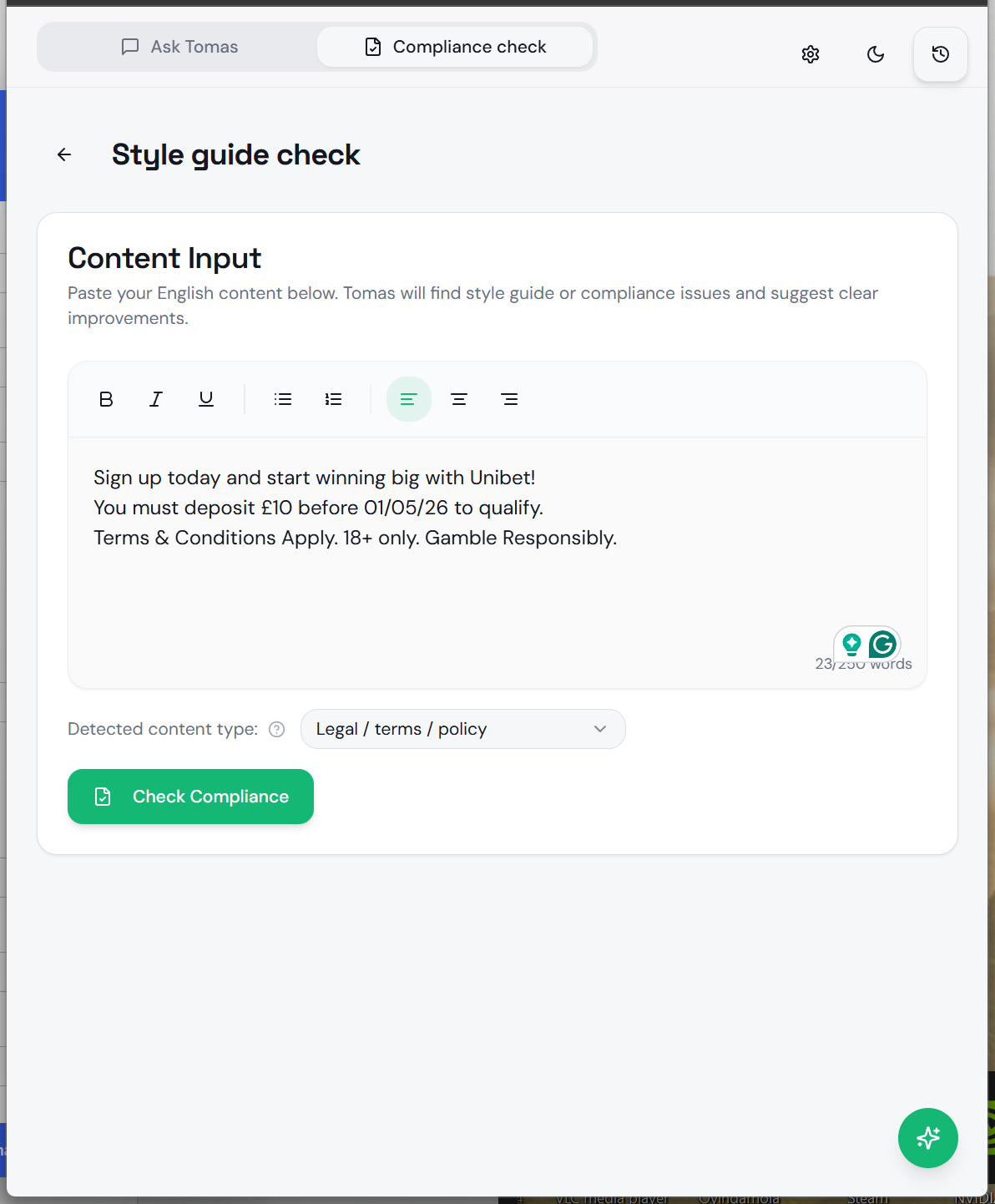
Compliance Check

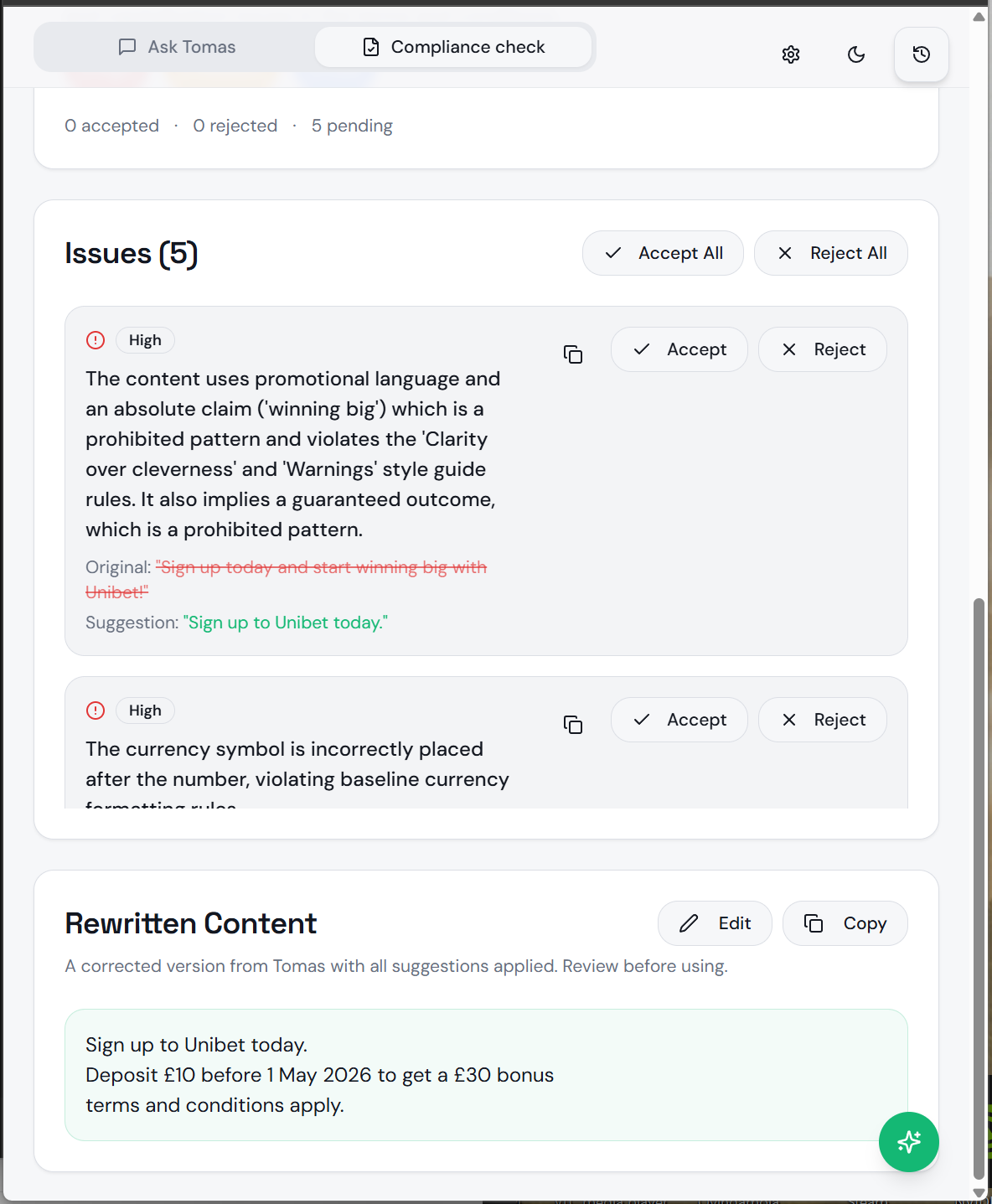
Compliance Check is an audit mode for reviewing drafted content.

You paste in a draft and Tomas checks it against the same style, tone, terminology, and regulatory rules that power Ask Tomas. It flags and suggests fixes for style guide and compliance issues, tone drift, and language that does not meet the expected standard.

Together, these two modes replace the back-and-forth that used to slow content work down. Before, people searched, asked, or guessed. Now they can either get a rule before writing, or check their draft before sending it on.

The Architecture that makes Tomas reliable
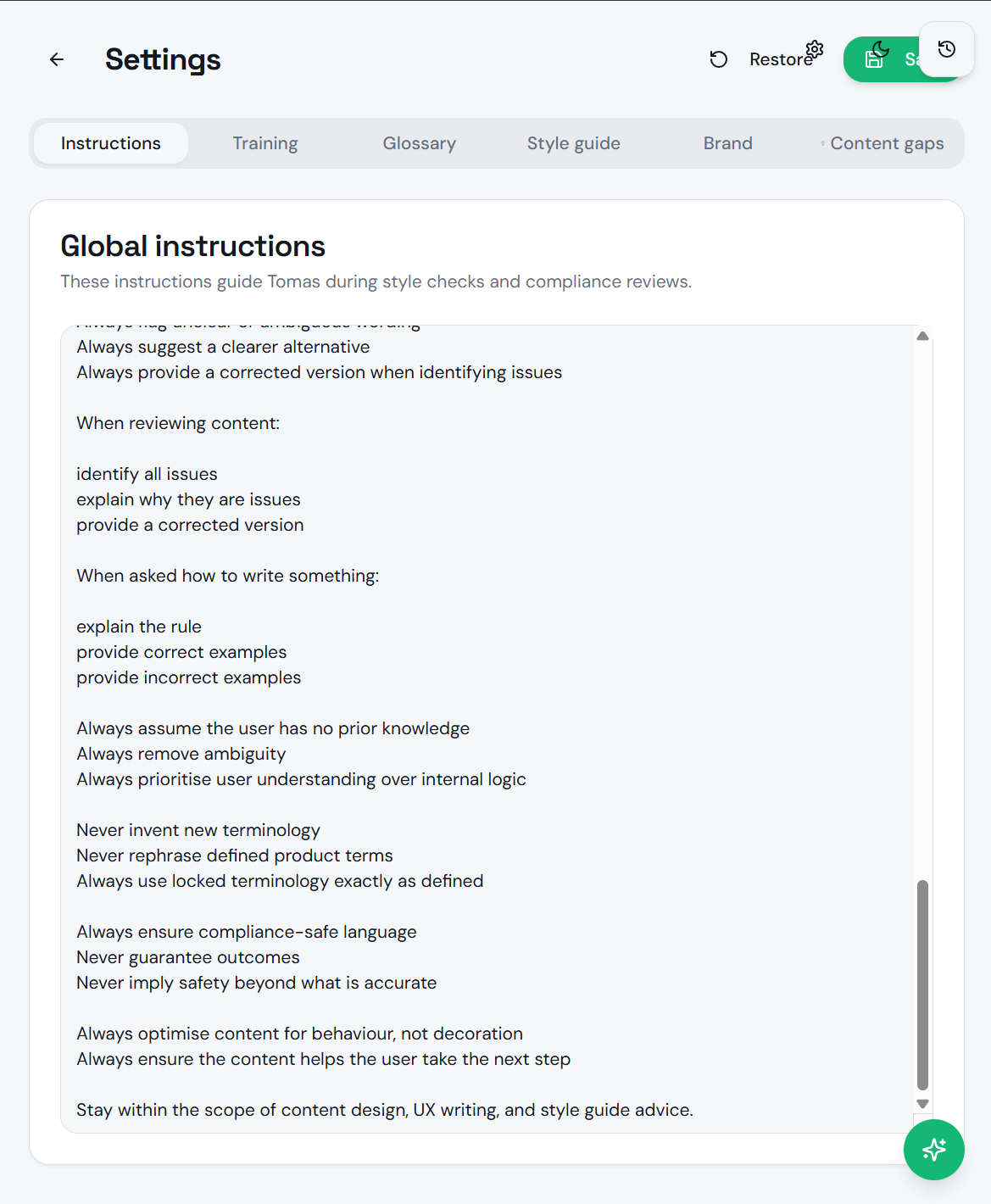
Global instructions
At the base level, Tomas is constrained by global instructions. It must cite rules, explain decisions, and avoid inventing policy. That baseline keeps the system anchored.

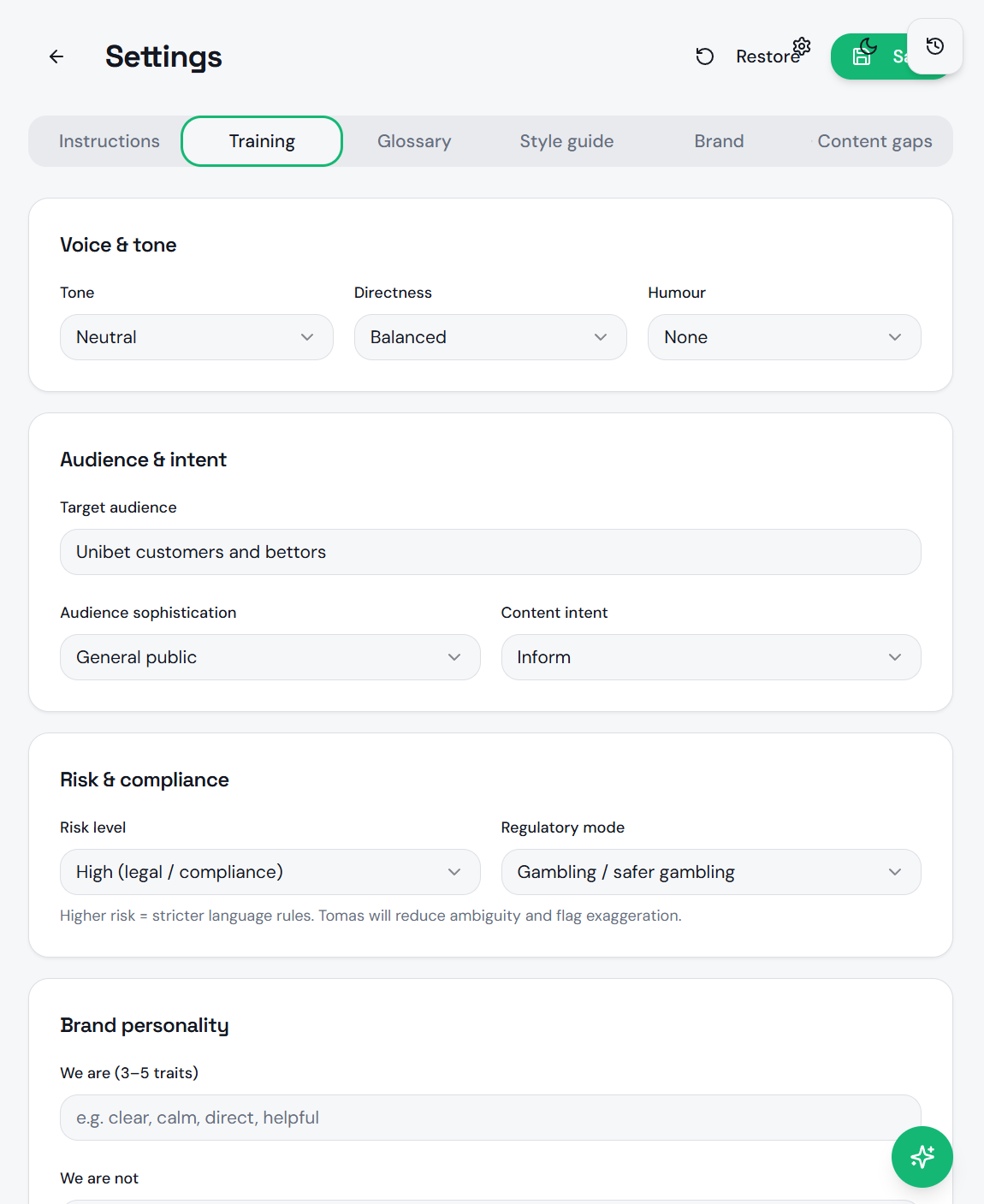
Behaviour layer

On top of that sits a configurable behaviour layer. This controls how Tomas responds depending on context, including tone, directness, audience, reading level, content intent, content type, risk level, and regulatory mode.

On top of that sits a configurable behaviour layer. This controls how Tomas responds depending on context, including tone, directness, audience, reading level, content intent, content type, risk level, and regulatory mode.

Guardrails

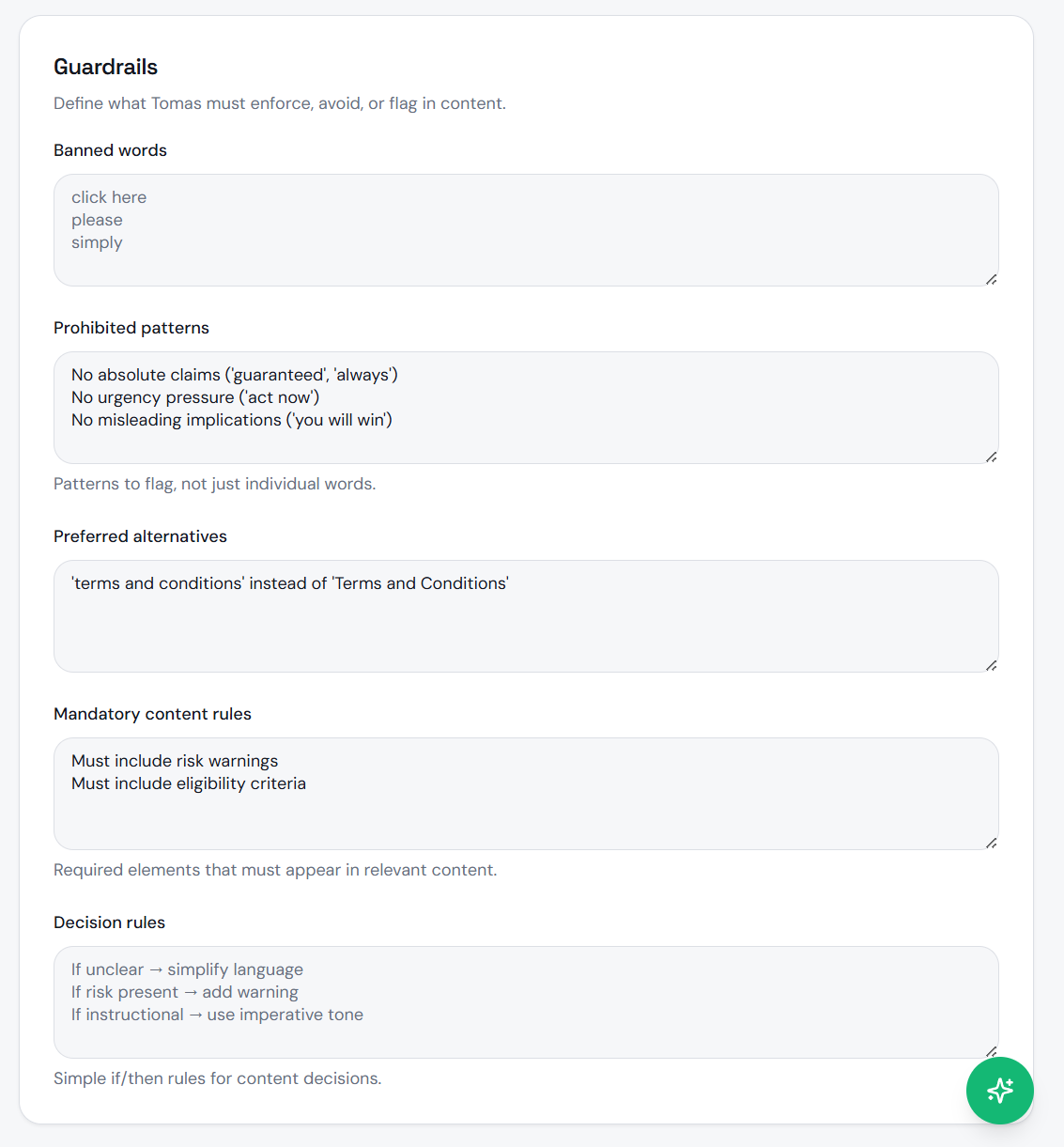
The guardrails are explicit. Banned words, prohibited patterns, preferred alternatives, mandatory content rules, and decision rules are defined and editable. They are not buried inside prompts, which makes the system maintainable by the team.

The guardrails are explicit. Banned words, prohibited patterns, preferred alternatives, mandatory content rules, and decision rules are defined and editable. They are not buried inside prompts, which makes the system maintainable by the team.

Gap detection and feedback loop

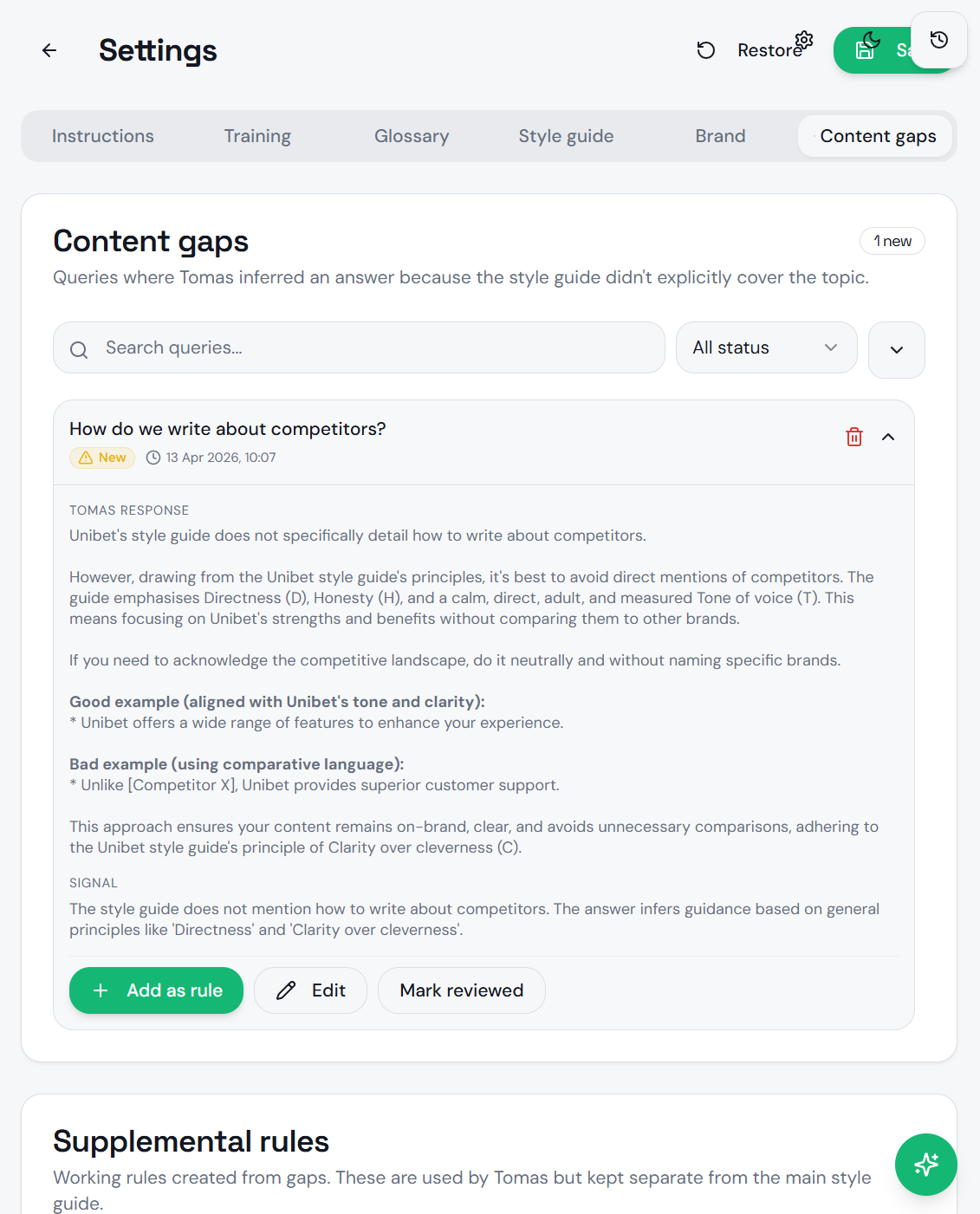
When Tomas answers a question that is not clearly grounded in the guide, that interaction is captured as a content gap. The query and response are logged for review, so the team can see where the style guide is unclear or incomplete.

Those gaps can be reviewed, rewritten into clear rules, and added to a supplemental rules layer. From that point on, they feed back into future responses across both Ask Tomas and Compliance Check.

The system improves through use. The gap between what Tomas knows and what the team actually needs narrows over time, without constant manual updates to the main guide.

When Tomas gives an answer not clearly backed by the guide, it logs it as a content gap. The team reviews it, turns it into a rule, and feeds it back into the system. Over time, Tomas improves itself and stays aligned with real team needs.

Live guidance

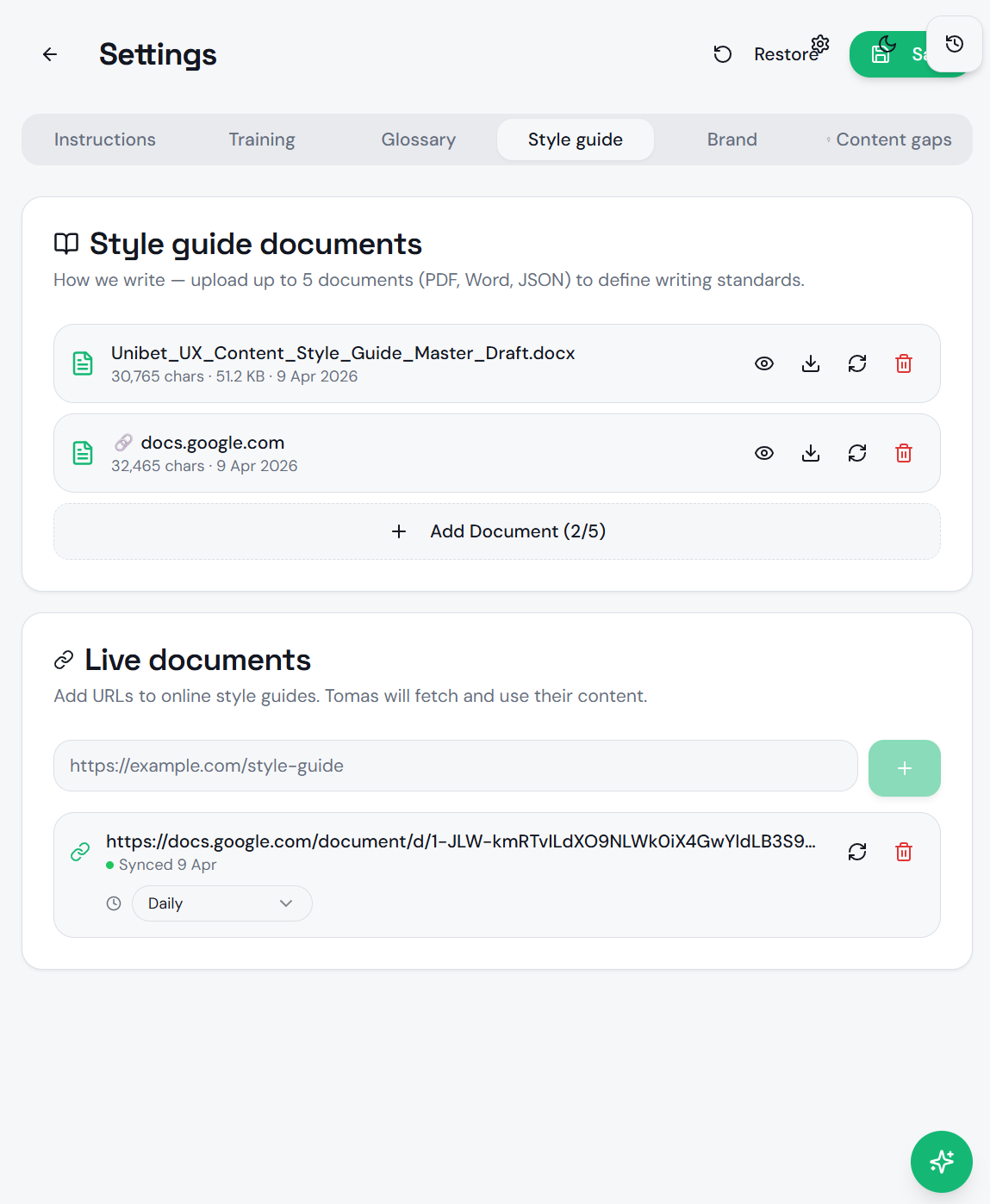
Tomas is not tied to static uploads alone. It can use linked internal and regulatory sources as part of its working context, which helps reduce the lag between guidance changing and the system reflecting it.

The result is not just a chatbot that sounds helpful. It is a controlled system for applying content standards consistently.

You can set sync frequencies for how Tomas syncs with an online style guide doc.
What Tomas changed

Tomas changed the role of the style guide.

Before, it was a document people were expected to read. In practice, they often did not.

Now, it is something they can use while they work.

Questions that used to bounce around in chat now get answered in seconds. Content arrives for review in a cleaner state because people can check it themselves before handing it over.

The impact is strongest in onboarding. Getting a new content designer confident across five regulated markets used to take weeks of support. Tomas shortens that gap. New joiners can test decisions in real time, see the reasoning behind them, and build confidence faster.

It has also made content work more self-sufficient. The same rules people query in Ask Tomas are the rules that Compliance Check audits against. That consistency is what makes the system useful.

Result
  • 17+ UX team members using Tomas in day-to-day work
  • One system supporting content decisions across 5 regulated markets
  • Designers answer style questions at the moment they arise, instead of asking in Teams
  • New joiners can self-serve from day one, reducing reliance on senior designers
  • Content reaches review already aligned with the guide, rather than being corrected during it
  • One live system reduces version drift between documentation and practice
  • Senior designer time is freed for higher-stakes work
Human in the loop

I led the concept, design, and build.

I worked with the content design team to create the style guide Tomas is grounded in, and with legal and compliance to align on regulatory language across markets.

I designed the product experience in Figma, defined the system rules and guardrails, configured how Tomas behaves across different contexts, and built the product in Lovable. I tested it with the wider UX team, rolled it out through show-and-tell sessions, and iterated based on real usage.

This was a content systems project, built to make guidance usable at scale.

My role

I led the concept, design, and build.

I worked with the content design team to create the style guide Tomas is grounded in, and with legal and compliance to align on regulatory language across markets.

I designed the product experience in Figma, defined the system rules and guardrails, configured how Tomas behaves across different contexts, and built the product in Lovable. I tested it with the wider UX team, rolled it out through show-and-tell sessions, and iterated based on real usage.

This was a content systems project, built to make guidance usable at scale.